It is very common when people ask me about the B-hive story (my previous start-up i co-founded and was acquired by VMware in 2008), that they want to know how much luck was involved in the success and timing of it all. I personally think think luck had very little to do with it but it seems like if you ask some of our brightest technical minds, they would feel luck played a bigger role. here is what i think about luck in general and its role in technology start-ups.
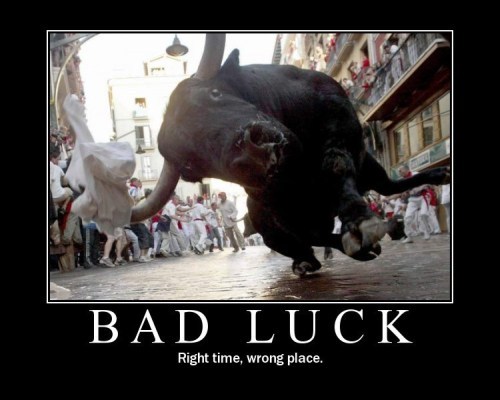
1.The belief in luck
luck is a religion in the sense that a person that believes in luck basically assumes control to his fate to an external force and that force is a contributor or a detractor mostly to his goals. in addition luck is viewed as an innate treat (you are a lucky guy or bad luck ruins everything in your life) with some vague social rules that define how you can please or upset the gods of luck. like religion (which according to recent neuro-psychology studies seems to be part of human evolution), Luck helps in providing a set of rules that binds a group and deters foreign group members and it also reduces the burden of responsibility on our actions in life.
management 101 teaches us that one of the main factors that created the industrial revolution (which created the management as science movement) was the rise of the protestant church in western Europe after years of catholic domination. the reason protestants were a catalyst for the industrial revolution is the belief that a person’s fate in this world is highly influenced by his actions with the help of god but basically god helps those who help themselves (as opposed to the catholic view which places emphasis on the next world and the complete dominance of god in this world’s fate.
In this sense, whatever luck is, the sheer belief in it a self-fulfilling prophesy, it is great if you believe that you are lucky and a disaster if you think you are not innately endowed with luck.
the bottom line in here is that the belief in luck is a negative for entrepreneur:
– an entrepreneur that believes in luck and also believes he lacks luck should probably keep his day job and not start a company of any kind.
– an entrepreneur that believes he is lucky, will fail to see the connection between his actions and the results and fail to learn the right lessons. Her over confidence might be a positive force in overcoming rough times but compared to the learning gaps it created, it’s over-all a bad trait for tech entrepreneurs.
2. What is luck actually?
weather it is bad or good, we all feel some people are lucky and some are not so what is the rational explanation to this?
Professor Richard Wiseman University of Hertfordshire has published a few papers on the matter which to me seem to explain how luck is really a set of practices and traits that make you “lucky”. Basically, in his research what Wiseman found was four factors that separate lucky people from the unlucky ones:
- Being open to new experiences which in turn will present new opportunities (in Woody Allen’s words – 80% in life is showing up)
I have seen so many tech companies fail because of their fear of letting other people know what they do. they never tell their families and friend what they are up to and they are afraid to tell investors what they are doing while waiting in their garage for the perfect moment in which their product is going to be so good, it will be impossible to out-do it or steal it and it will be able to sell itself. Socialize the idea as much as possible, you never know if that person you are talking to you can teach you something / be your next customer / be your next investor. i always find it funny how technology start-ups spend so much time looking and thinking about their small competitors instead of their customers. this often creates a culture of paranoia and discreteness which is counter-productive to a start-up whose main challenge will always be that no one knows what it does. - Spend time at the end of the day remembering what went well that day
There is an overwhelming amount of data and lessons that we acquire as we start a new tech company. taking time at the end of the day to reflect on those things that went well helps us do two things: 1. refine the learning process 2. realize the progress that is being made and celebrate it. - listen to your instincts more
As technology people we tend to be very much empirical and methodological, value to scientific method and assume that instincts are for reptiles. the reality is, that the brain is well tuned machine for learning and tuning in both social as well technological problems. your instincts are a lot of times the end result of an unconscious learning process that spits a result without showing you the algorithm for the sake of simplicity and performance. as we well know, the computation abilities of our brains are superior to any learning/analysis algorithm a human can come up with when it comes to most problems, especially the kind that involve other people. while scientific methods are helpful in some cases of large data crunching scenarios (pattern matching in numerical fields), a lot of multi-dimensional problems are already solved in our brains and the results are available – it’s called our instincts. - Teach yourself to see view you as a lucky person – luck is a self fulfilling prophesy (see part 1)
Going back to the first part – if you do implement the first 3 lessons but still see your fate controlled by this force called “bad luck”, you are doomed for failure. technology entrepreneurship is a delicate schizophrenic balance in which you need to be confident enough in face of all the nay-Sayers but still attuned to what they are saying in case there is any valuable information in there.
To conclude, while luck certainly exist in the rare singular extremes of the spectrum (you walk in the park and branch hits you on the head and kills you or alternatively, you win the lottery with the first ticket you bought by mistake), luck should be viewed as a controllable force. Assuming too much powers to luck is never a good thing for a technology entrepreneur.
Good luck?

 Sand & Boulders
Leave a comment