With the team in place, all that is left are two things, the first is to start solving a problem that your team can deliver and that someone will need a solution for and the second is to execute.
There are two common ways to set the direction of the team, you either start from the solution or you start from the problem. when starting with the solution you might have a concept of something cool that someone needs but you can’t really articulate the who, why and when they would pay for it and most probably, the problem you will end up solving will be very different than what you had in mind when you started. when starting from a problem you know of a hole that needs or will need to be filled and you have some idea about how you would start building the solution but most chances you will discover the biggest challenges from the technology side after you started implementing the solution.
Between the two options it seems like younger entrepreneurs embarking on less expensive endeavors would go for the first while the latter is usually the course chosen by more experienced entrepreneurs (who also have more capital at their dispense) but both work only if the team is able to keep a plan while maintaining an open mind to the changing environment around them.
Most chances are that the problem you are set to solve along with your eco-system is going to change drastically from the time of inception as time passes and this is where the team capabilities to adapt and predict becomes more important than anything else.
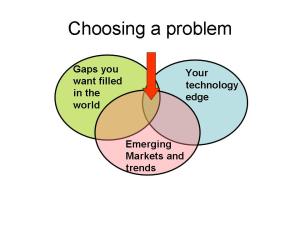
How to qualify the problem you are going to solve – the best problem is one that doesn’t exist yet or exists, is still small enough that no one cares about it but is on its way to be huge and that you have some unique abilities or knowledge to solve (the 3 domain in the diagram above).
the best case scenario is one in which you start solving the problem when it’s small enough that no one knows about it or cares to solve it (often referred to as greenfield) , you deliver your solution when your customers are well aware of it and willing to invest efforts (time, money, resources, etc.) to solve it and that the problem grows exponentially with you on top of it as a solution provider (i have always found it amusing in the past when talking to VCs, a guy who has never touch a surfboard in his life would explain to me that you want to start to paddle before the wave arrives , stand to ride as it forms and let push you forward as it grows and brakes in the right direction – the analogy is right but the person delivering it, often wouldn’t know a surfboard from a harpoon).
I often get asked by folks that want to start something new “but how do you know what you want to do?”. Well a good exercise is taking the 3 domain above and start filling in the circles with lists. The easiest is the “what you/your team actually have an edge in” since that relies on your collective past experience and is not that long of a list. The second thing to do, is have a rolling list of gaps you would like to solve in the world, ideally, you are drawing on your domain experience and therefore the shared area with the first domain should have some options in it. Don’t wait for a eureka moment and don’t sit with your team and brainstorm as that will probably not yield much. instead, it is better that each member go for a week or two with a notepad or any accessible recording device and write things as they pop up. Return to those later with the team to flush them out and start honing on a direction. The last part is to assess how those direction fall within the macro directions you guys can predict the markets are taking and what would cause each trend you are listing to grow.
Don’t forget, in the grand scheme of thing, the last domain is impossible to predict. If Bill Gates didn’t see the Internet coming and none of the financial wiz guy saw the latest economic downfall, your chances of foreseeing the next thing accurately are pretty small.


 Sand & Boulders
Leave a reply to yoavdembak Cancel reply