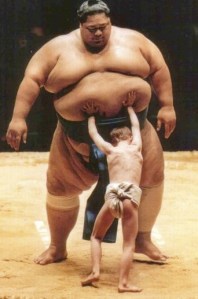
One of the most common questions an entrepreneur gets when socializing his idea or start-up is “you do know that Microsoft/Cisco/Oracle <place name of a relevant large corporation> is already looking into that field, right?” . As i often tell people, there better be other people looking to solve the same problem as there is no better validation for it. The bigger the company that is looking into that area, the better. That said and done, just trying to do a “me too” or “me cheaper” while competing with the big company is a hard way to win the fight for a start-up. So how does a small entrepreneur makes gains in a market eyed by large players? I recently read a book called “Beginnings – first times in the bible ” by a known Israeli author, Meir Shalev, who takes a look at a lot of the famous stories in the Hebrew bible and sheds a brilliant secular light on them. One of the interesting chapters in the book was about the David and Goliath battle and how David’s use of innovative technology and go to market strategy in the battle shifted the forces to an unpredictable ending.
There is a common misconception about the story that it depicts an underdog and a miraculous win over an evil powerful opponent. When actually reading the original story, the outtake is different and more educational. The Philistines (the people that ruled the coastal strip neighboring Israel – no relation to the Palestinians of today) are at war with Israel (led by king Saul) and in order to save the lives of many soldiers, a proxy 1-to-1 fight is proposed (a similar situation was depicted in the movie Troy as was common in that period). Goliath was a 7 foot experienced soldier that represented the Philistines and the Israeli camp could not find the contender on their side to fight Goliath for a few days.
David was an underage boy whose brothers were enlisted in the army and was sent by his father to deliver them something in the front camp. David is already introduced in a previous story as an entrepreneurial guy with high aspirations and reaching the Israeli camp, he realizes the opportunity at hand to propel himself towards being a future king (80% is showing up after all). Once volunteering to the task , he gets dismissed by kind Saul due to the concern that Goliath is an experienced and powerful man of war while David lacks any experience as a warrior. Given the lack of options, David gets the part and the first thing he does as he prepares for battle is to shed the heavy sword and armor that were the common warrior attire at the time. He then proceeds to carefully pick 5 well rounded river stones (aerodynamics and target impact) and hides those in his clothing along with an ancient version of slingshot which is made out of a6 foot leather string that is held from both ends in the hand while the rock is placed in the middle as the sling is turned around the head only to be released from one end thus causing the rock to fly in a liner trajectory to the target (which means more speed and distance to the stone than a slingshot).
David then shows up to the battle running towards Goliath holding a stick as a diversion thus upsetting his opponent as well as using his speed and agility to his advantage. Before Goliath is able to take a step towards David or lift his sword, David gets to a range close enough to hit Goliath with a stone from his sling but far enough so that Goliath can’t reach him. He takes the sling and the stones he was hiding and with one punctual throw, hits Goliath in the forehead and due to the shape and power of the stone, it collapses the skull bone above his nose and takes Goliath out by causing damage to his frontal lobes (very CSI, i know). While Goliath drops down to earth, David runs to him and uses Goliath’s sword to finish the job.
so what are the lessons here:
1. A big challenge is a big opportunity – David realizes that while this battle is very hard, winning it will yield a big reward (Kingship). In a start-up perspective, seek a problem that is hard to solve but one that has big companies looking at it already. It’s ok to have most other companies afraid to take on a dominant player but if the dominant player doesn’t exist, you probably don’t want the fight.
2. People will doubt you – If this is your first start-up, doesn’t matter what your idea or potential execution is, you will be discredited. don’t seek validation by asking permission. it’s your job to prove it. Idea’s are meaningless, execution is everything.
3. Small players win by changing the rules – You won’t be able to win a direct competition by going head to head with Microsoft or Oracle, they have more money and more experience and playing to their rules with a “me too” or “me cheaper” hardly ever works.
4. Technology is the most efficient way to change the rules – The reason why VCs are willing to listen to your pitch for a new cloud infrastructure but not to your new Indian-French fusion restaurant is that technology is a proven way that small players can make a difference in a short time frame. Yes, big players can get there eventually if they keep trying but the combination of agility and technology innovation are the way to keep ahead or at least cause enough damage to be acquired.
5. Avoid the direct fight while you can – If possible, aim for greenfield rather than legacy. When picking a market, the optimal one is the one that is currently too small to be of interest, will grow fast in the future and your technology edge gets you there fast. once the big guys get there, you already have the higher ground so that you are either the big guy in the not-so-green-anymore field or you are dominant enough that it’s cheaper to acquire you rather than fight you.
6. and most important – realize and seize the opportunity – the best technology that never gets to be used in the right place and the right time is meaningless.


 Sand & Boulders
Leave a reply to Lee Patenaude Cancel reply